Buried treasure is one of those Minecraft rewards that feels personal. You are not just mining random blocks or trading with villagers. You are following a map, crossing oceans, and digging in the exact right spot for a chest that someone else already “hid” in the world. And yeah, it
Buried treasure is one of those Minecraft rewards that feels personal. You are not just mining random blocks or trading with villagers. You are following a map, crossing oceans, and digging in the exact right spot for a chest that someone else already “hid” in the world.
And yeah, it usually has diamonds. Heart of the Sea. Sometimes iron, gold, and food when you are lucky.
But finding it properly is not as simple as just walking to the red X and digging straight down. That is how players end up lost, confused, or digging for ten minutes in the wrong chunk.
So let’s fix that.
Buried treasure is a hidden chest generated in world structures, usually under sand or gravel near beaches and ocean areas. It is always linked to a treasure map, which you must find first inside shipwrecks or ocean ruins.
The chest is buried, not visible on the surface.
That is the entire challenge.
No markers. No clues except the map.
It is one of the few Minecraft features that pushes exploration instead of mining or fighting.
Before you can find treasure, you need the map.
There are two main sources:
Shipwrecks are underwater structures that look like broken wooden ships. Inside them, you can find chests, and one of those chests often contains a buried treasure map.
Ocean ruins also sometimes contain treasure maps inside their loot chests.
Once you pick up the map, it will show:
Now the real search begins.
Treasure maps are not like normal maps.
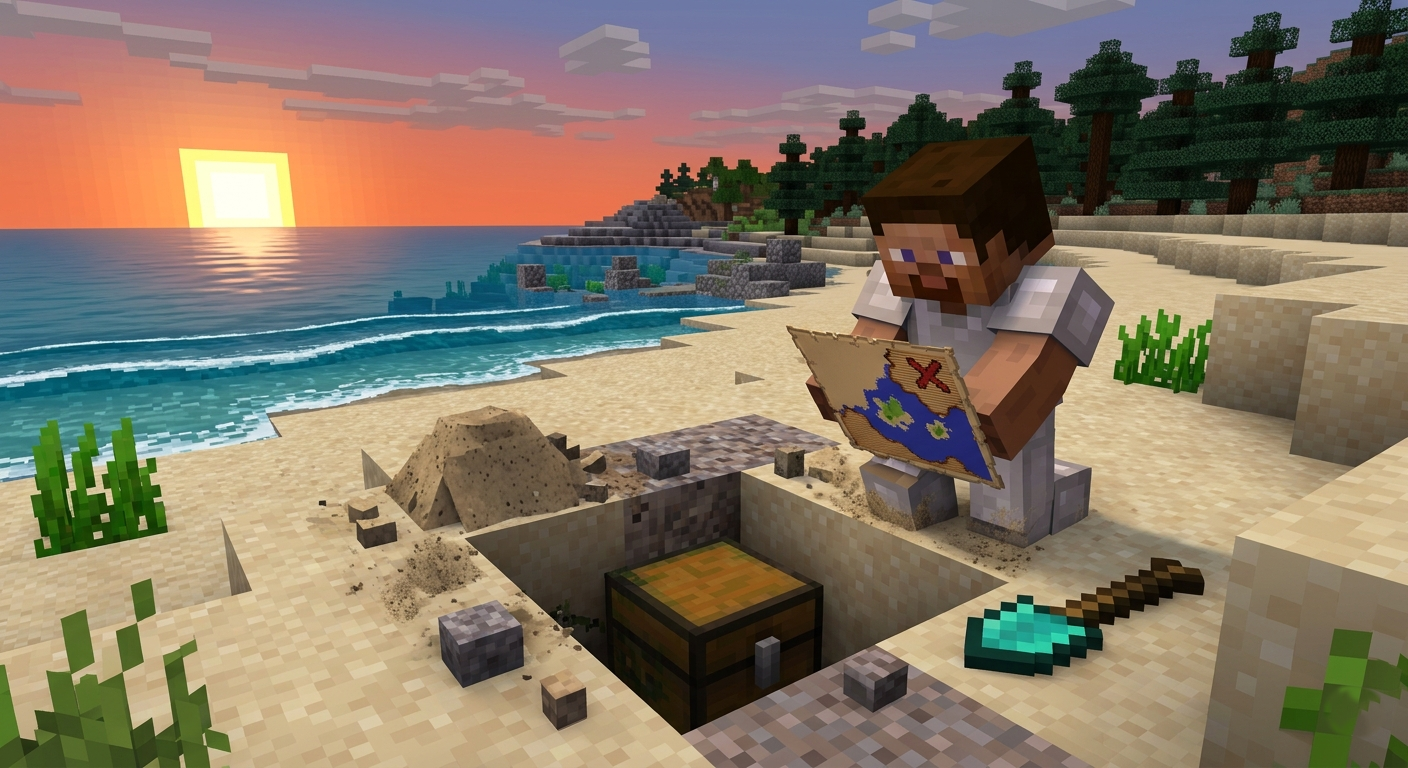
They only reveal terrain around the treasure area, not the entire world. The red X marks the exact chunk where the chest is buried.
Your job is to align your position marker with that X.
Simple idea. Slightly tricky execution.
Important mechanic:
The treasure chest is usually buried between Y-level 45 and below, often just under sand, gravel, or stone near beaches.
That means digging randomly is a bad strategy.
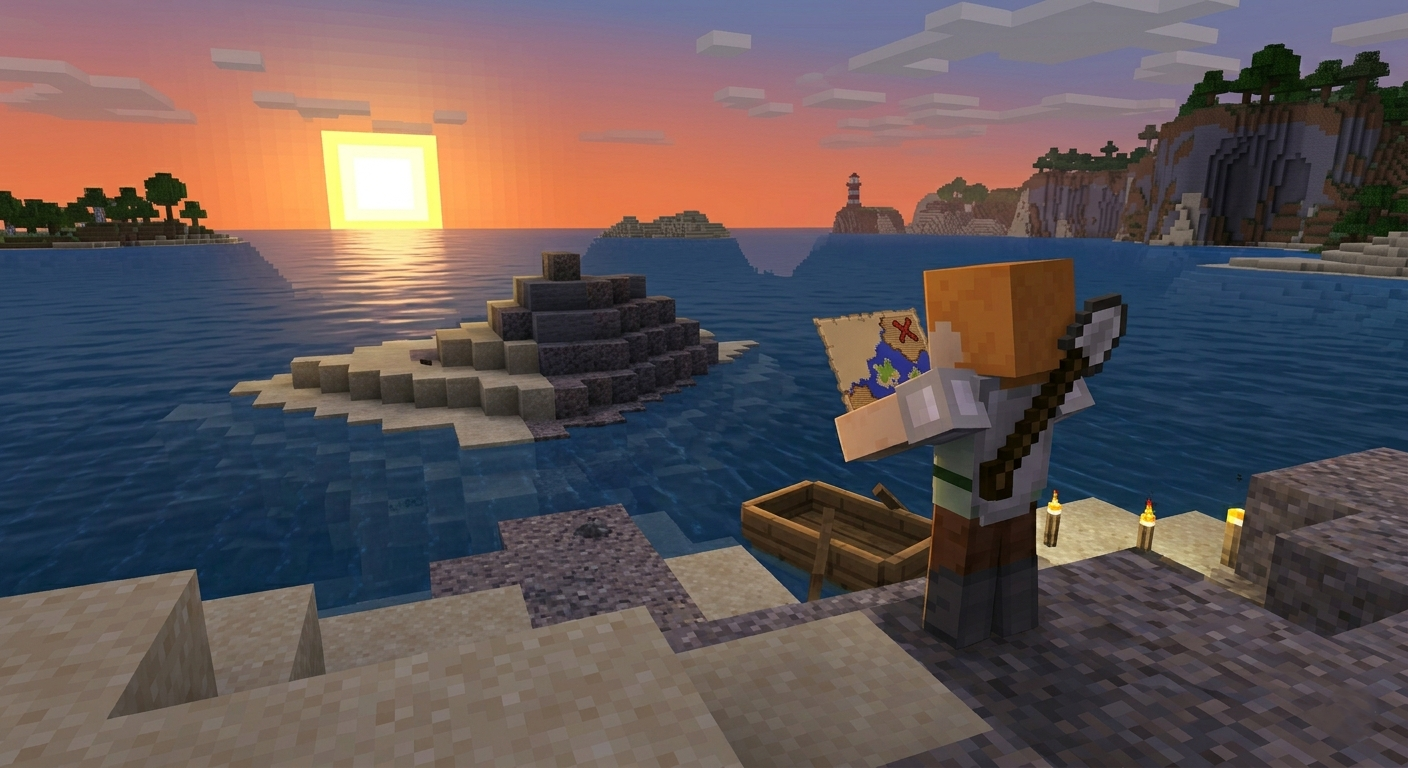
Open your map and look at the white player marker.
Now move slowly.
You want to match your marker with the red X on the map.
Once you are close enough, the map will fully “fill in” and show you exactly where you are standing on top of the X.
That is your signal.
You are basically there.
Now comes the digging part.
Most players mess this up by digging too wide or too deep in the wrong direction.
The treasure is almost always buried:
Do not tunnel randomly. That wastes time.
And yes, sometimes the chest is underwater nearby instead of fully buried on land.
Minecraft likes surprises.
Buried treasure chests are worth it.
Common loot includes:
The Heart of the Sea is especially important because it is used to craft a Conduit, which gives underwater breathing and buffs.
That alone makes treasure hunting valuable.
Buried treasure always spawns near beach-type terrain.
Good places to search:
If you are already exploring shipwrecks, you are basically in the right area.
This is where most treasure hunts fail.
Players dig before fully aligning the map marker. That leads to wasted time.
The chest is not always deep. Sometimes it is just under one or two blocks.
Many treasure chests generate partially or fully underwater.
You do not need to mine half the beach. Precision wins.
If you want faster treasure runs:
Speed comes from preparation, not luck.
Buried treasure is one of Minecraft’s simplest but most satisfying systems.
No complex crafting.
No fighting bosses.
Just exploration, navigation, and a bit of patience.
Once you learn how maps align with the red X, treasure hunting becomes almost routine. And that moment when you break the final block and see the chest sitting there?
Still hits every time.
FREE game server, VPS, web host, dedicated IP & more on most plans!
Get Started