
Leather feels simple at first. Just a few cows, a couple of kills, and you are done, right? Then bookshelves enter the picture. Enchanting setups. Item frames everywhere. And suddenly leather becomes one of those resources you are always low on. It sneaks up on you. So the real question
Leather feels simple at first. Just a few cows, a couple of kills, and you are done, right?
Then bookshelves enter the picture. Enchanting setups. Item frames everywhere. And suddenly leather becomes one of those resources you are always low on.
It sneaks up on you.
So the real question is not how to get leather. It is how to get a lot of it, consistently, without wasting time wandering around hoping cows spawn nearby.
This guide breaks down every reliable method, from early survival tricks to full farming setups that actually scale.
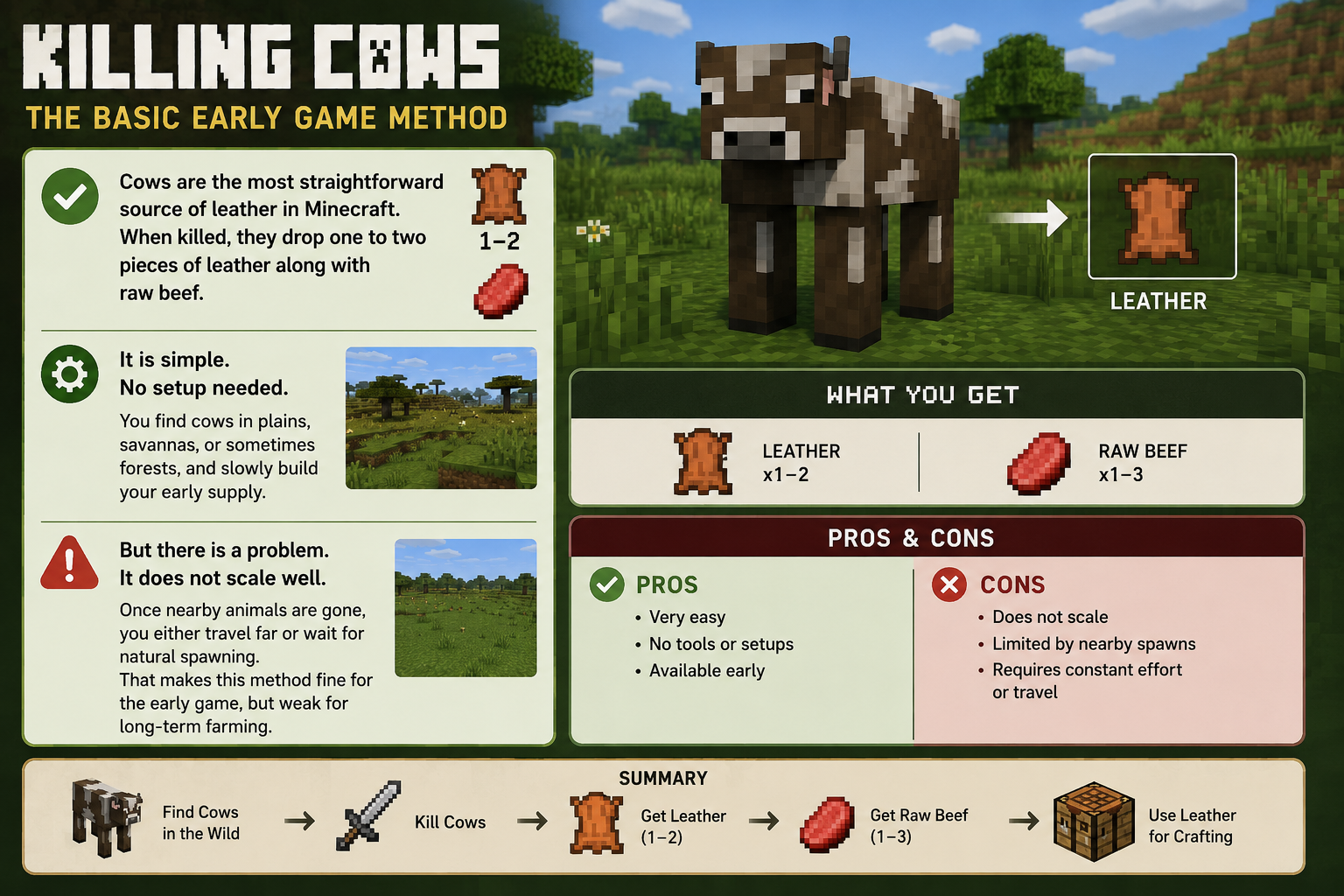
Cows are the most straightforward source of leather in Minecraft. When killed, they drop one to two pieces of leather along with raw beef.
It is simple. No setup needed.
You find cows in plains, savannas, or sometimes forests, and slowly build your early supply.
But there is a problem.
It does not scale well.
Once nearby animals are gone, you either travel far or wait for natural spawning. That makes this method fine for the early game, but weak for long-term farming.
Looting helps, but not enough to turn this into a serious farm.
If you want large amounts of leather, you eventually build a cow farm. There is no way around it.
It is one of the simplest animal farms in Minecraft, but also one of the most effective for leather production.
A cow farm works by keeping cows in a confined space, breeding them repeatedly, then controlling the population for efficient killing.
The loop is simple:
That cycle repeats endlessly.
Cows reproduce quickly when fed wheat. That means you can generate new mobs without exploring. Unlike hunting, this is renewable and controlled.
Once stable, a cow farm becomes a permanent leather source.
Advanced players take cow farms further using automation mechanics.
You can use:
This reduces manual effort dramatically.
The goal is simple.
Less clicking. More leather.
Cows are not the only source of leather in Minecraft.
Other mobs also drop it, but they are less efficient.
Horses drop leather when killed. However, they are not ideal for farming because they are not commonly bred for resource production.
Llamas also drop leather, but again, spawn rates and farming efficiency are low compared to cows.
They are not designed for farming. Their drop rates and availability make them unreliable for bulk leather production.
Think of them as bonus sources, not your main system.
Fishing in Minecraft has loot tables that include leather, especially when using a fishing rod without the Luck of the Sea enchantment.
You can sometimes catch:
It is slow, but passive.
Fishing works while you are doing other tasks. Some players use AFK fishing setups to passively collect materials over time.
It is not fast, but it is steady.
And sometimes, steady wins.
One of the most efficient modern methods of getting leather in Minecraft is trading with leatherworker villagers.
Leatherworkers can trade:
Villager trading is renewable, scalable, and does not depend on mob spawning.
You can set up:
Once that system is running, leather becomes effectively unlimited.
Hoglins, found in the Nether crimson forests, drop leather when killed.
They are aggressive mobs, meaning farming them requires more preparation.
In the late game, hoglin farms become a strong secondary leather source because they are renewable and can be farmed using Nether-based spawning systems.
They are not beginner-friendly, but very powerful later.
If the goal is consistent leather production, the answer is not complicated.
Cow farms are the backbone.
Everything else supports them or fills gaps.
Early game:
Mid-game:
Late game:
Leather looks like a small resource.
Until you need stacks of bookshelves, item frames, armor sets, or storage labels.
Then it becomes important fast.
The good news is that Minecraft gives multiple paths to get it, but only a few scale properly. Once you build a cow farm and connect it with basic automation, leather stops being a problem entirely.
At that point, it is just another material flowing into your storage.
FREE game server, VPS, web host, dedicated IP & more on most plans!
Get Started