Daylight Sensors are one of those quiet redstone blocks that make your world feel more alive. Lights turn on at night. Doors react to sunrise. Farms shift automatically without you touching anything. It is basically Minecraft watching the sky for you. And then reacting to it. Once you understand how
Daylight Sensors are one of those quiet redstone blocks that make your world feel more alive. Lights turn on at night. Doors react to sunrise. Farms shift automatically without you touching anything.
It is basically Minecraft watching the sky for you.
And then reacting to it.
Once you understand how it works, you stop manually controlling half your base.
A Daylight Sensor is a redstone block that detects the time of day in Minecraft and outputs a redstone signal based on sunlight levels.
It responds to:
The stronger the sunlight, the stronger the signal.
At night, it weakens or completely changes its behavior depending on its mode.
It is mainly used for automatic systems that depend on day and night cycles.
Simple idea. Very powerful automation tool.
Crafting a daylight sensor is not complicated, but it requires glass and nether quartz, which means you need early Nether access.
You craft it using a crafting table with:
They are arranged in a specific pattern:
Once crafted, you get one daylight sensor.
That is it.
No upgrades required to start using it.
Before crafting, you need three main resources.
Smelt sand in a furnace. Sand is found in deserts, on beaches, and on riverbanks.
Found in the Nether by mining quartz ore. It is one of the most common Nether resources.
Crafted from any wood type by placing 3 planks in a horizontal row.
Easy materials overall, but Nether Quartz is the real gatekeeper here.
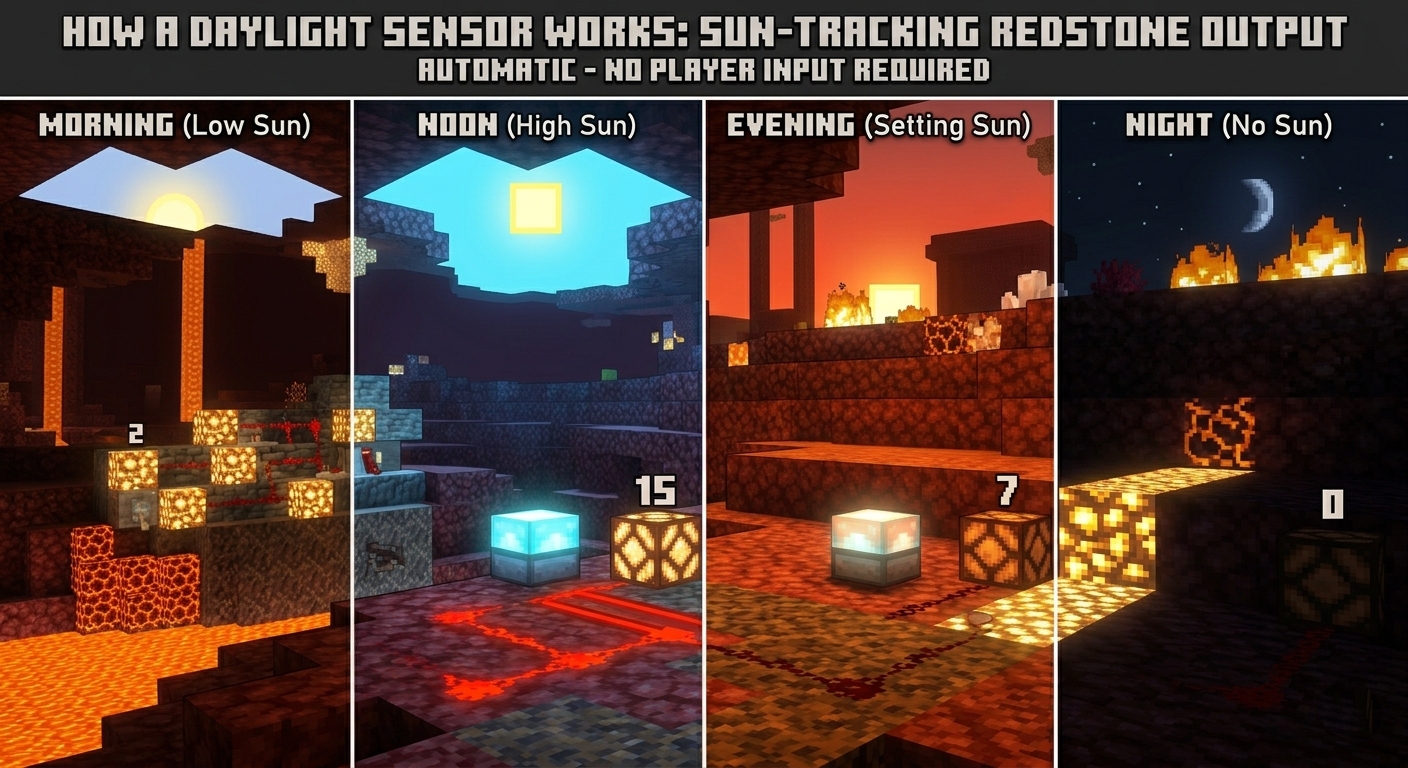
A daylight sensor measures light levels from the sky.
Here is what happens in simple terms:
The output is a redstone signal that changes automatically over time.
No player input needed.
It just follows the sun.
Daylight sensors have two modes that change how they behave.
Used for most builds.
This is useful for night-based systems like automatic lighting.
Small switch. Big difference.
Once placed, a daylight sensor can power redstone directly or connect to circuits.
Common uses include:
You just place it on the ground and connect redstone dust or components to it.
No complicated setup required.
This is the most popular use.
Basic setup:
At night:
During the day:
It feels clean and realistic.
Almost like real street lighting.
A few small mistakes can break the system:
Daylight sensors only work properly when they can “see” the sky.
That is the key rule.
They are best used in:
Anywhere you want time-based automation.
A daylight sensor is not flashy. It does not explode, move blocks, or fight mobs.
But it quietly controls time-based logic in your world.
Once you start using it, you stop thinking about switching lights on and off.
Minecraft just handles it for you.
Day becomes day.
Night becomes night.
And your builds react on their own.
FREE game server, VPS, web host, dedicated IP & more on most plans!
Get Started