Stepping on a block and watching something react instantly never stops feeling useful in Minecraft. A door opens. A trap triggers. A hidden base reveals itself. That simple idea starts with one small item: the pressure plate. It looks basic, almost forgettable. But it quietly powers a huge part of
Stepping on a block and watching something react instantly never stops feeling useful in Minecraft. A door opens. A trap triggers. A hidden base reveals itself. That simple idea starts with one small item: the pressure plate.
It looks basic, almost forgettable.
But it quietly powers a huge part of survival builds and redstone systems.
Once you know how to make it, you will start seeing it everywhere.
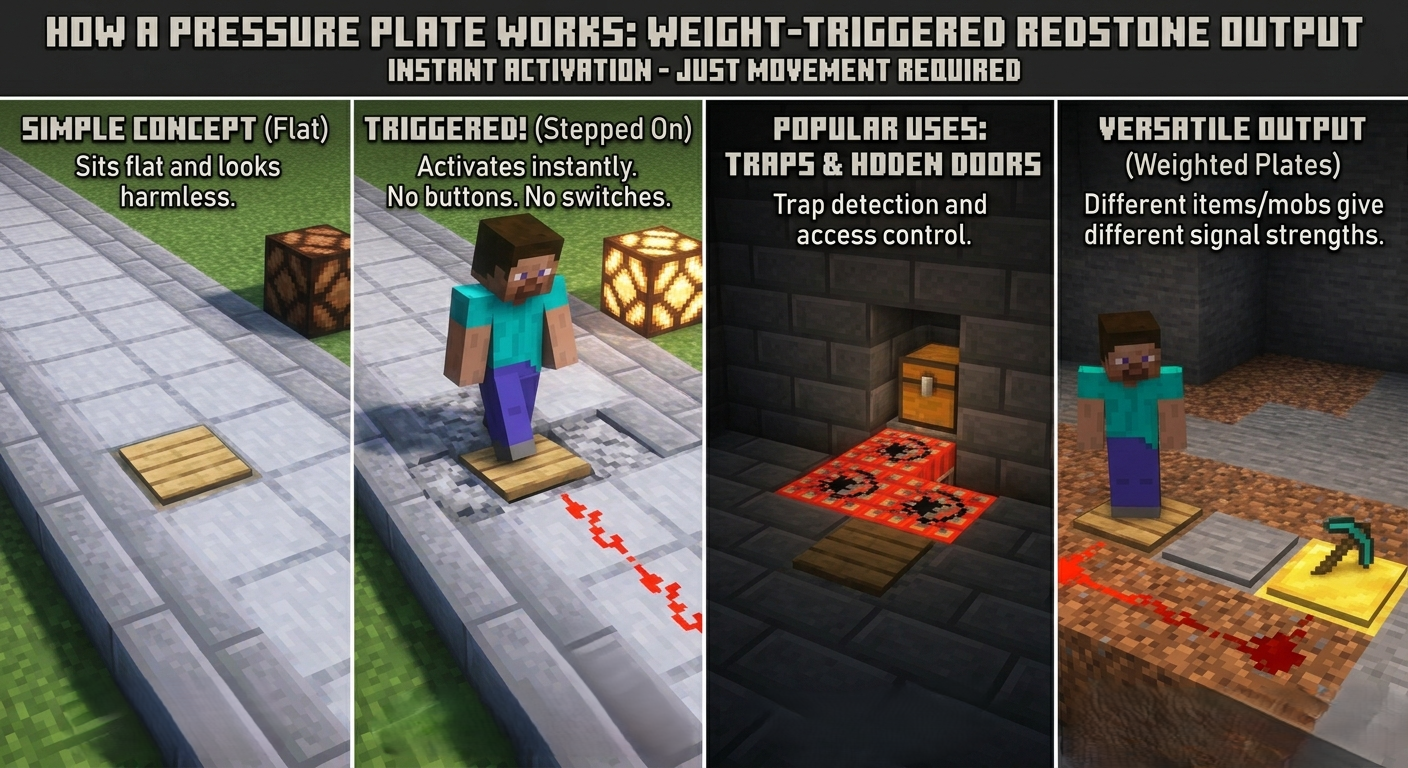
A pressure plate is a redstone activation block that sends a signal when something steps on it. That “something” can be a player, a mob, or items, depending on the type of plate.
It sits flat on the ground and looks harmless.
Then it activates instantly when triggered.
No buttons. No switches. Just movement.
That is what makes it so popular in survival and creative builds.
It is used for:
Simple concept. Big impact.
Crafting a pressure plate is extremely easy. You only need two matching materials and a crafting table.
Place the two items side by side in a horizontal row in the crafting grid.
That is the entire recipe.
But the material you choose changes how it behaves in-game.
Each type reacts differently depending on what steps on it.
Let’s break them down.
A wooden pressure plate is crafted using:
This includes oak, spruce, birch, jungle, acacia, or dark oak.
It activates when:
This makes it the most sensitive version.
It is commonly used for:
Very responsive. Very easy to use.
A stone pressure plate is crafted using:
It only activates when:
Items do not trigger it.
That one difference matters a lot.
It is used when you want more control, especially in survival bases where dropped items should not open doors or activate traps accidentally.
An iron pressure plate is crafted using:
This version works differently.
It activates based on entities standing on it and can detect presence more precisely in redstone systems.
It is often used in advanced builds where you want controlled detection instead of simple activation.
More technical. Less casual use.
Weighted pressure plates come in two versions:
These do not just turn on or off.
They measure how many items are on them and change the redstone signal strength based on that amount.
More items equal a stronger signal.
They are used in:
This is where pressure plates become “smart” components.
Once crafted, pressure plates immediately become useful in survival gameplay.
You do not need complex redstone knowledge to use them.
Just place them where movement happens.
They automatically handle activation when stepped on.
That is what makes them beginner-friendly but still powerful in advanced builds.
This is the most common setup.
Place a pressure plate in front of a door.
When you step on it:
When you walk away:
No buttons required.
It feels smooth and natural, especially for base entrances.
Pressure plates can connect to redstone systems that power pistons.
This allows:
Step on the plate and the structure moves.
It is one of the simplest ways to build hidden bases.
Yes, mobs can activate most pressure plates.
This can be useful or dangerous depending on your build.
Useful for:
Problematic because:
That is why stone plates are often used in safe builds.
Weighted pressure plates measure quantity instead of simple presence.
They produce different redstone signals based on how many items are on them.
This makes them useful for:
They act like a measurement tool rather than a switch.
Pressure plates are widely used in redstone because they react instantly.
They are often the starting point for automation.
Common uses include:
They make builds feel responsive instead of manual.
A pressure plate is one of the simplest items in Minecraft, but also one of the most useful.
It turns movement into action.
Step on it and something happens instantly. No delay. No interaction needed.
Once you start using them, you will notice they quietly power a huge number of builds in survival worlds.
Small block. Big effect.
FREE game server, VPS, web host, dedicated IP & more on most plans!
Get Started